Machine Learning for Classification of RF Signals is a university project for Automatic Modulation Classification, also known as AMC. The system classifies radio-frequency signals into 24 modulation types across 26 SNR levels, from -20 dB to +30 dB, using the RadioML 2018.01A dataset.
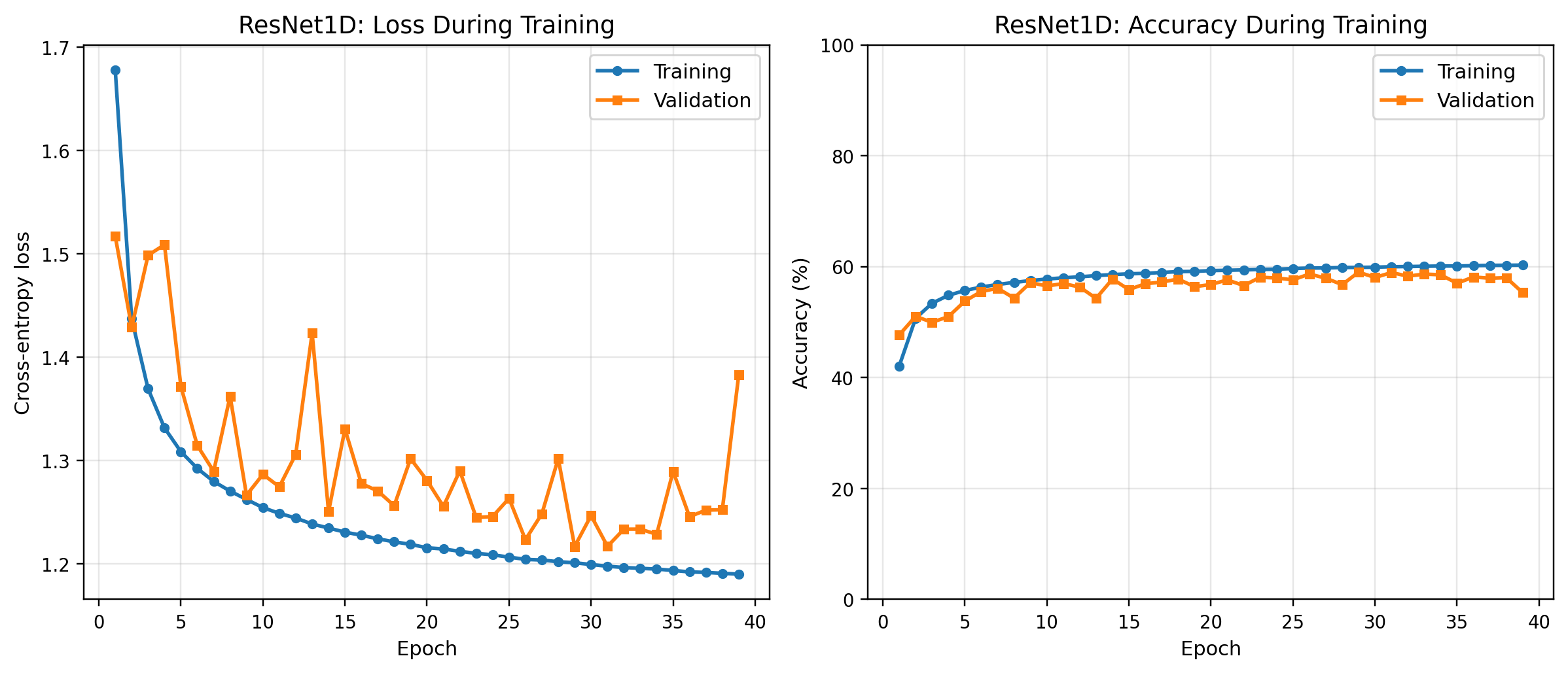
The project compares several deep learning architectures under a controlled protocol. Every model uses the same stratified 60/20/20 train, validation, and test split, the same random seed, optimizer, learning rate, batch size, epoch budget, and evaluation procedure. This makes the comparison focused on model behavior instead of accidental training differences.
What It Solves
Automatic Modulation Classification identifies the modulation scheme of a received RF signal, such as BPSK, QPSK, QAM, or OFDM, from raw I/Q samples without manual feature engineering.
This matters in spectrum monitoring, cognitive radio, interference or jamming detection, and adaptive communication systems, where the receiver needs to understand the signal type before demodulation or channel adaptation.
Dataset
The project uses RadioML 2018.01A, a large labeled RF dataset with 2.55 million I/Q signal samples. The split pipeline preserves the relationship between 24 modulation classes and 26 SNR levels, producing 624 stratified groups for fair training and evaluation.
Models Compared
The final results focus on three project-specific PyTorch architectures:
- CNN1D
- CNN-LSTM
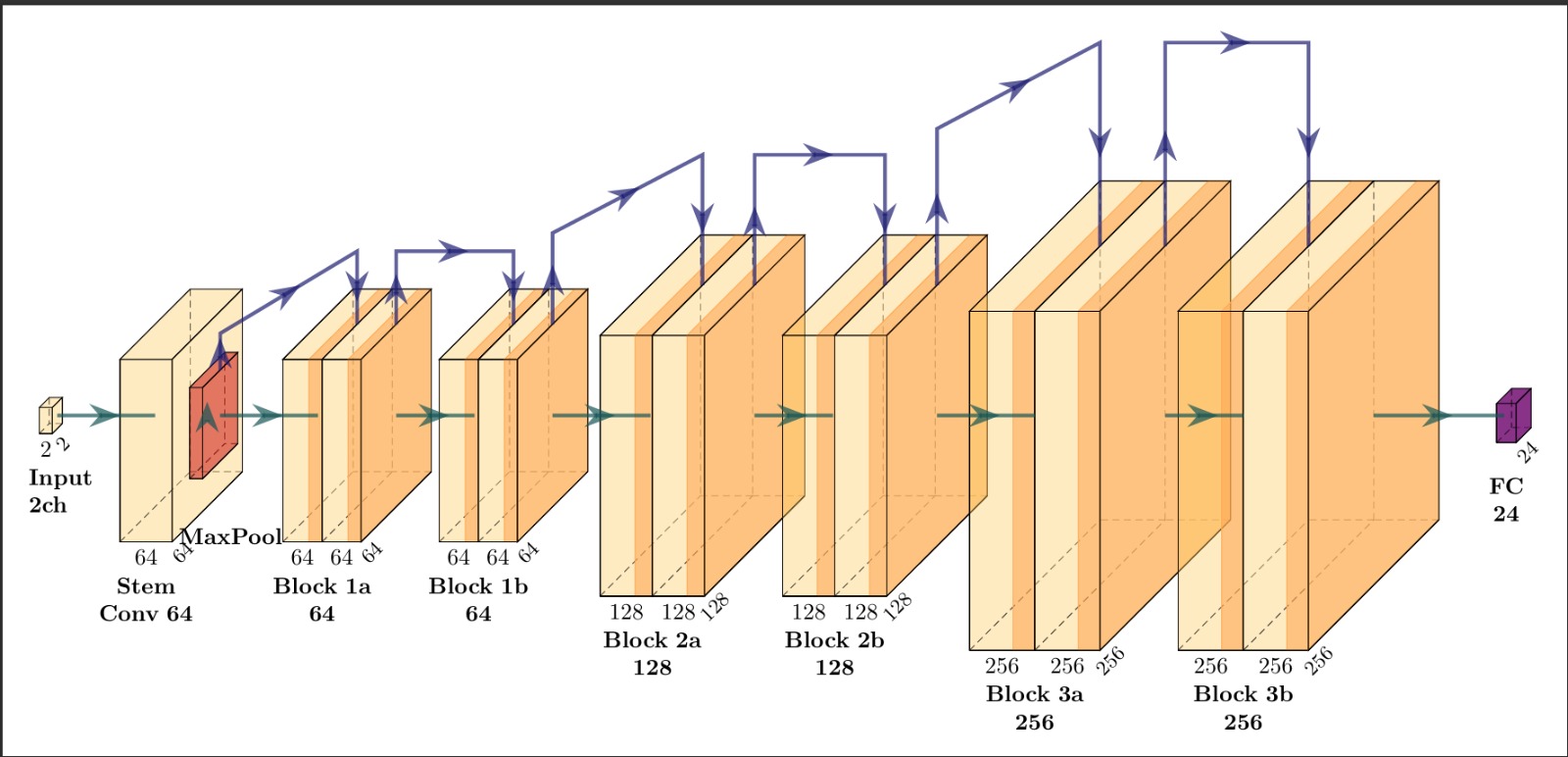
- ResNet1D
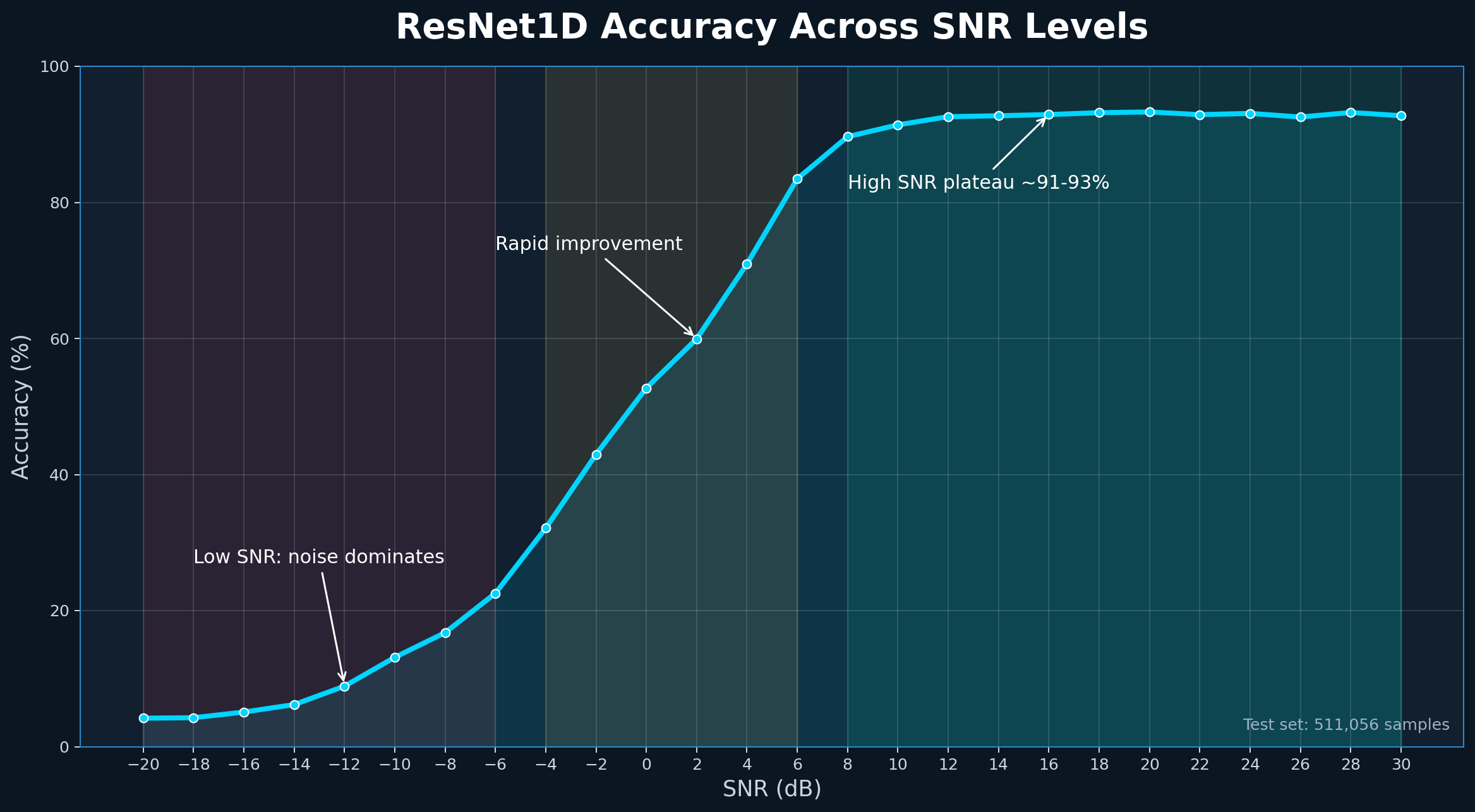
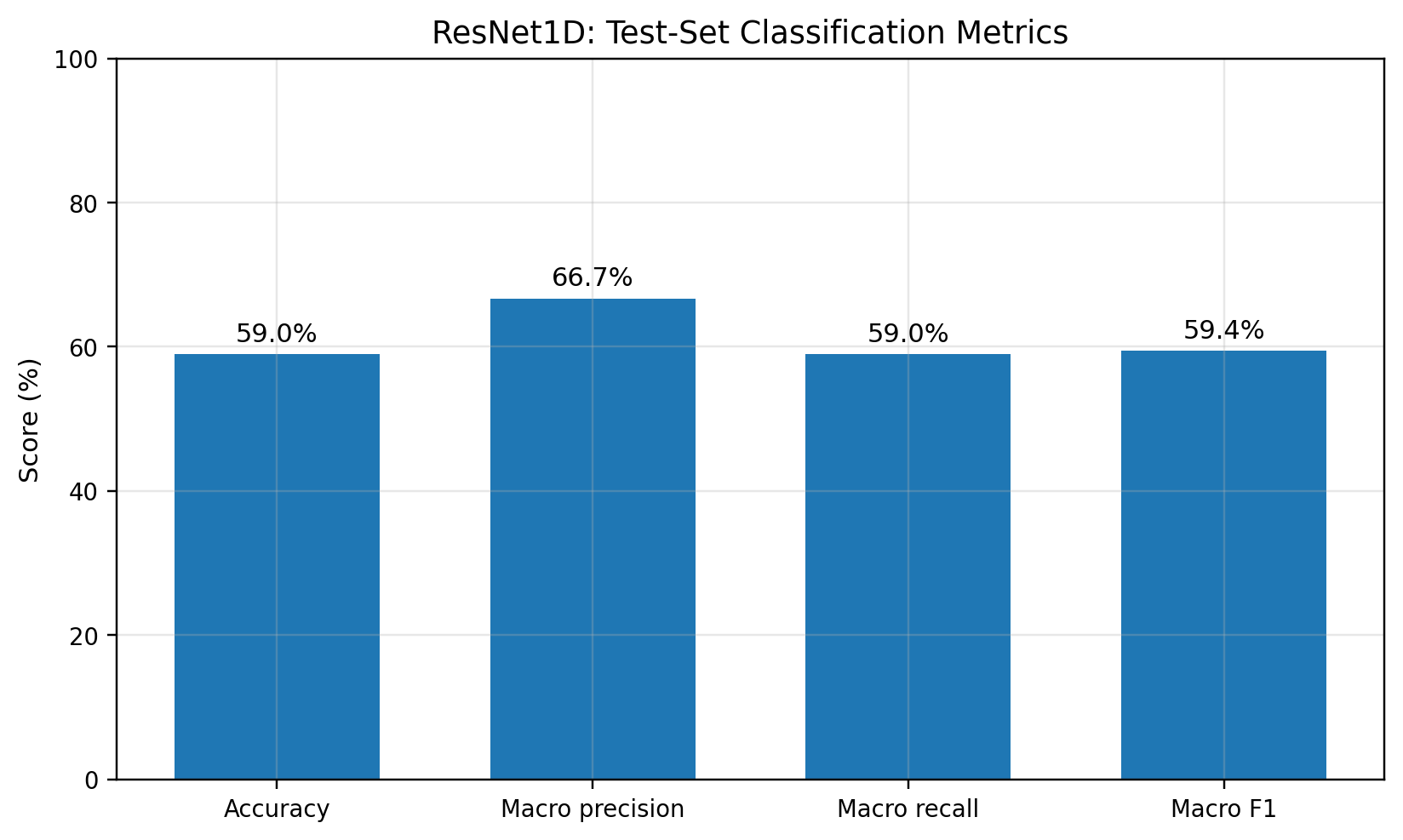
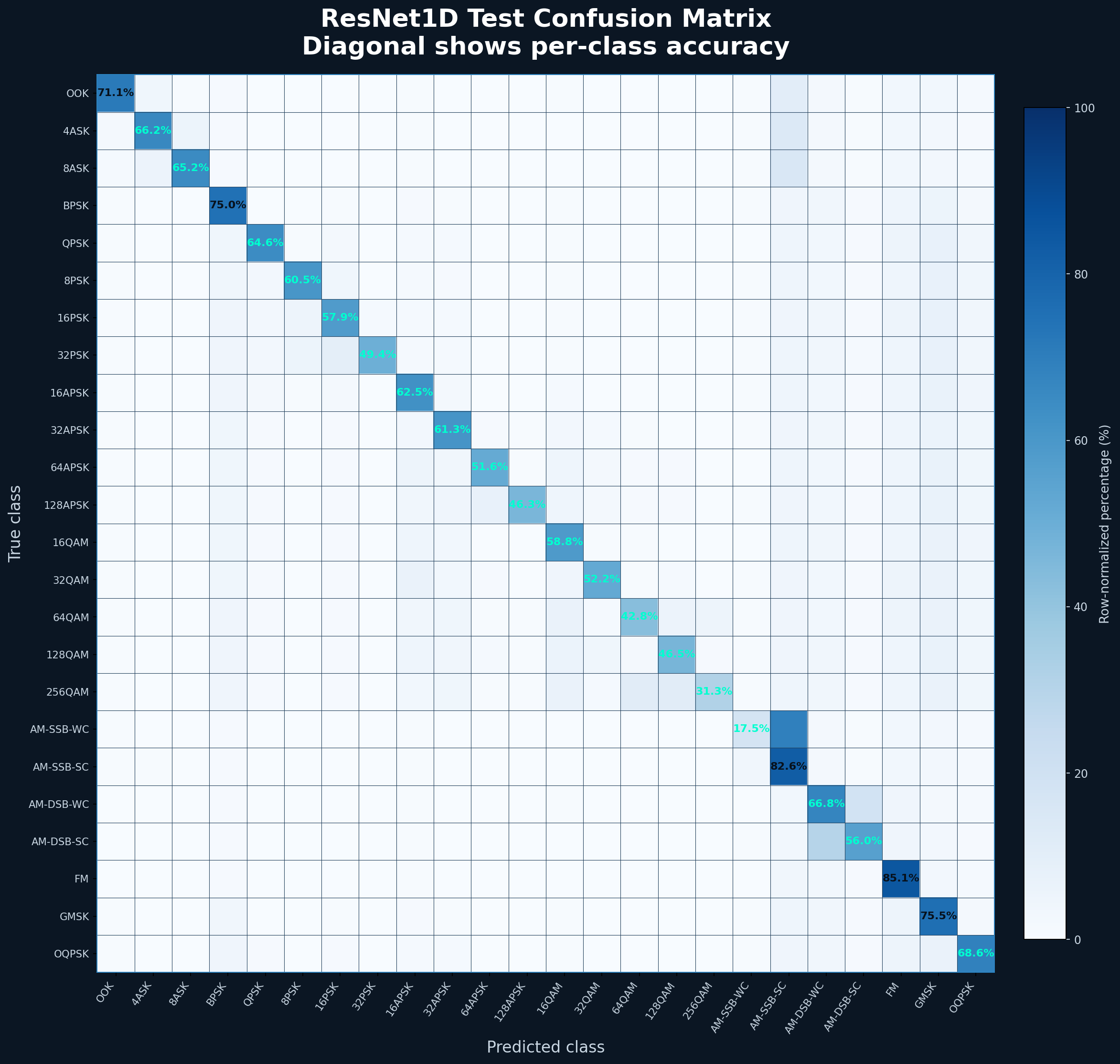
The strongest portfolio result currently comes from ResNet1D, with an overall test accuracy of about 59%. The accuracy-vs-SNR plot shows the expected RF behavior: performance is weak at very low SNR values and improves as the signal becomes cleaner.

ResNet1D accuracy by SNR level, used as the main portfolio thumbnail for the project.

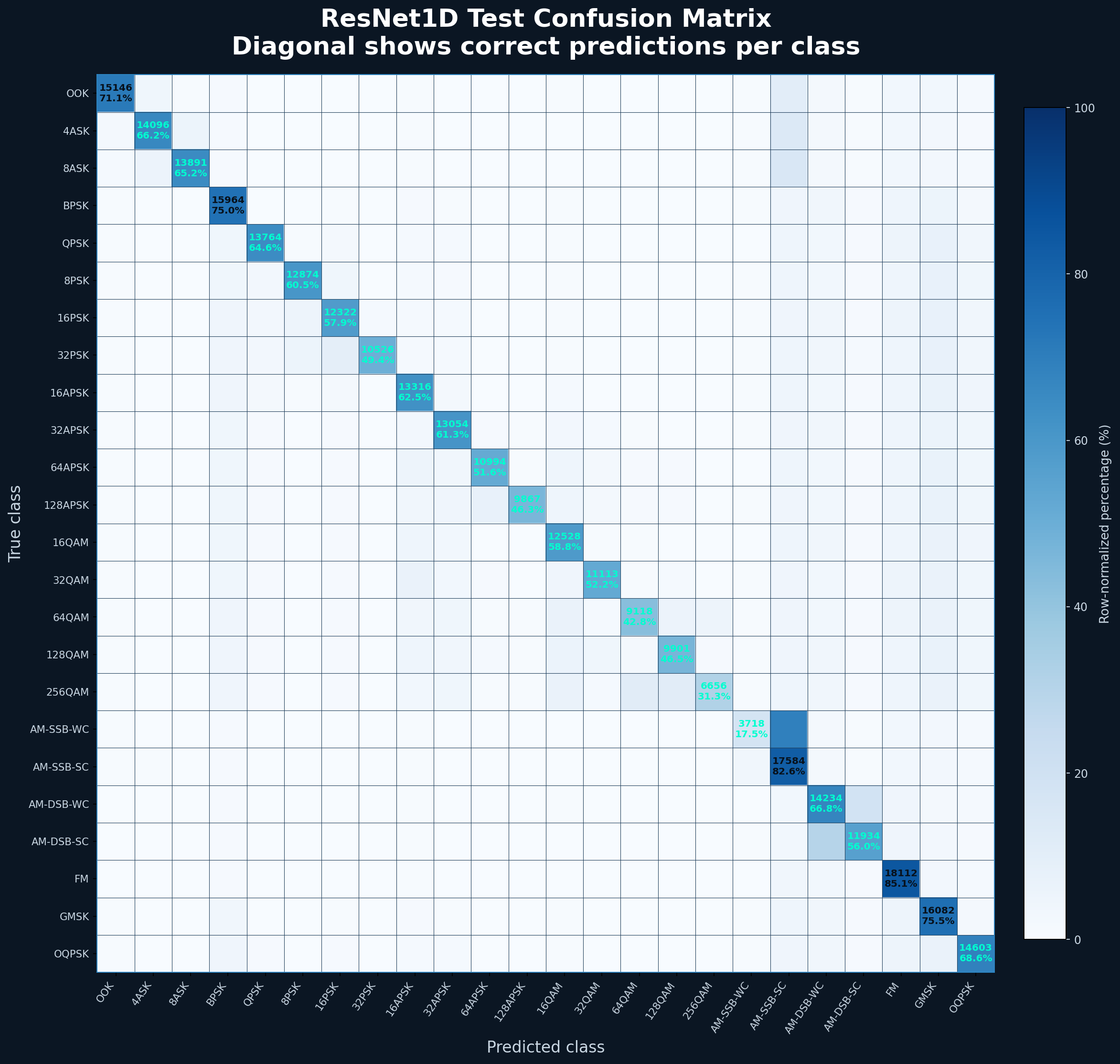
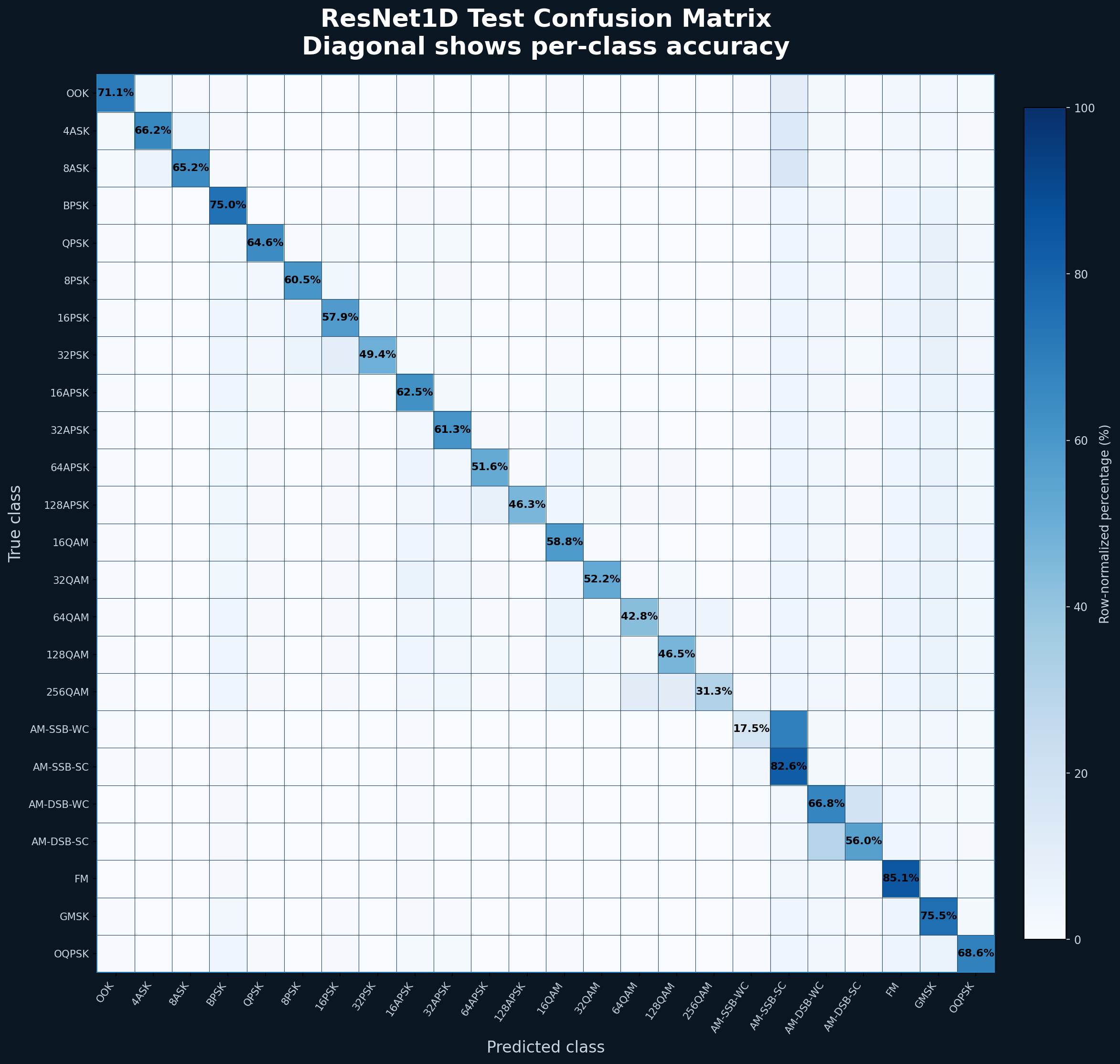
Annotated confusion matrix showing where the model separates or confuses modulation classes.
Pipeline
The project includes an end-to-end training and evaluation workflow:
- HDF5 dataset loading
- Stratified train, validation, and test split
- YAML-based experiment configuration
- Model factory pattern
- PyTorch training with early stopping
- Test-set evaluation with accuracy, precision, recall, and F1
- Per-SNR and per-class metrics
- Confusion matrix generation
- Cross-model KPI comparison
- MATLAB visualization export
- Docker and Docker Compose setup for reproducible GPU runs
Architecture Snapshots
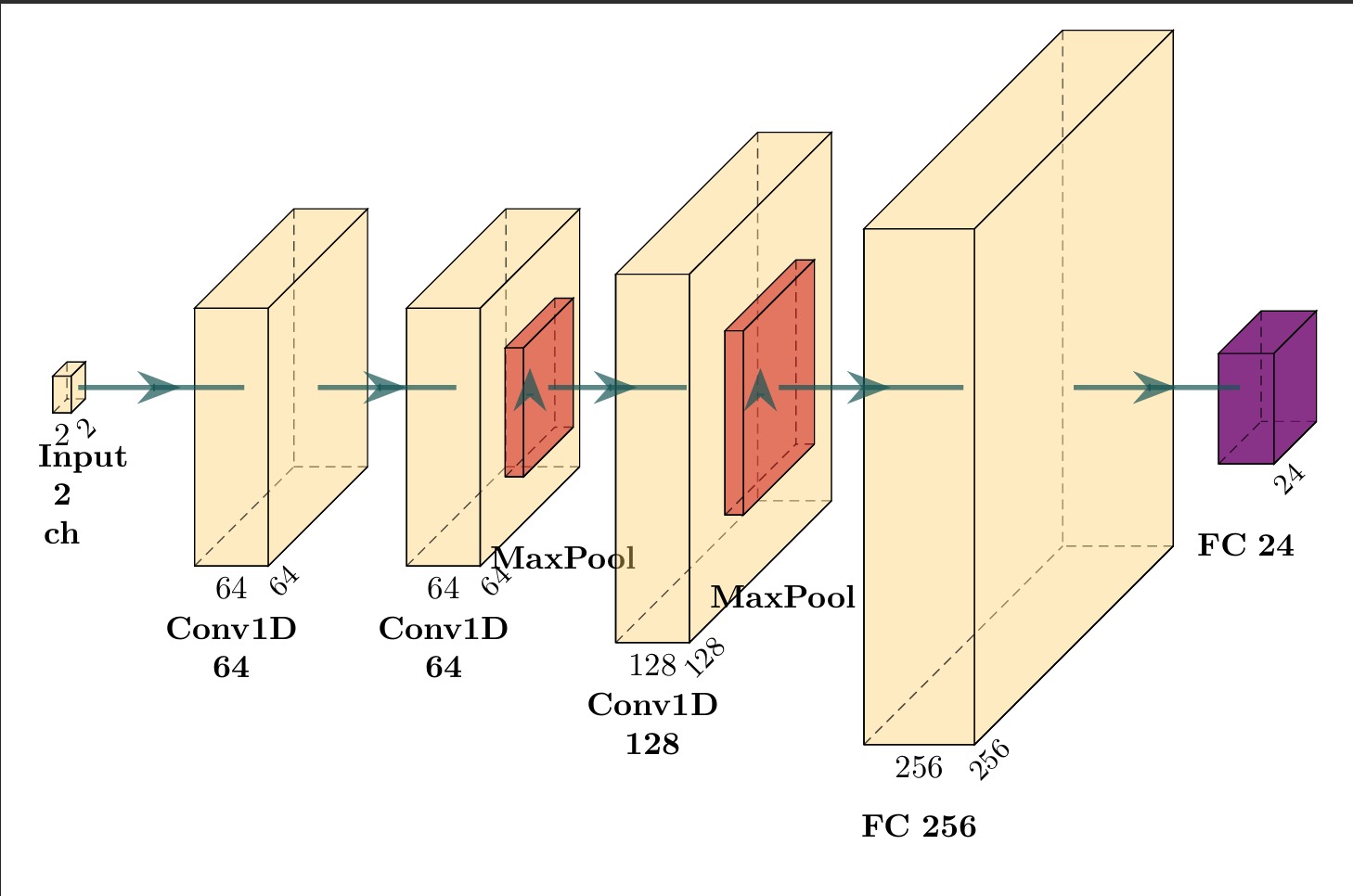
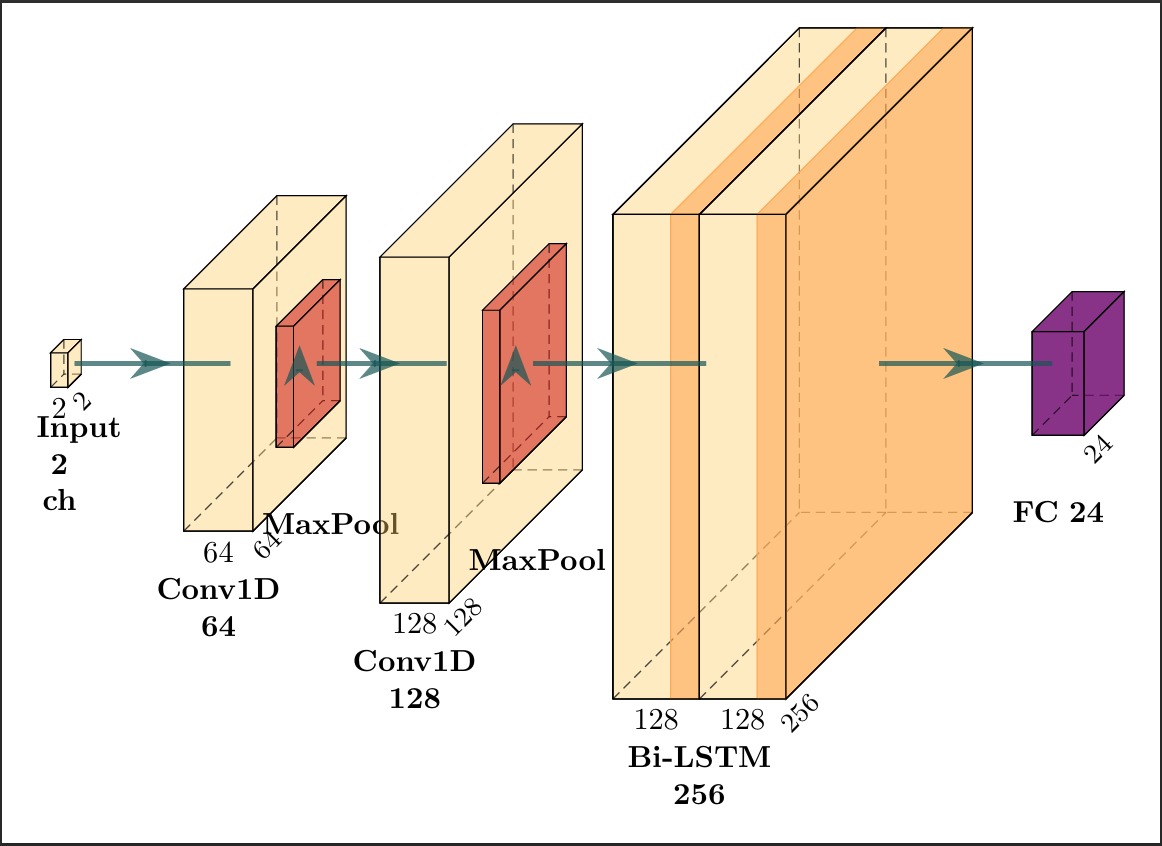
These diagrams show the three project-specific PyTorch baseline architectures. CNN1D focuses on local RF signal features, CNN-LSTM adds temporal sequence modeling, and ResNet1D uses residual one-dimensional blocks to support deeper feature extraction.


My Work
I built the end-to-end PyTorch training and evaluation pipeline, including src/train.py, src/evaluate.py, src/dataset.py, and src/utils.py.
I also implemented the stratified RadioML split pipeline, custom PyTorch baselines, YAML experiment configs, cross-model comparison tooling, MATLAB visualization scripts, and Docker-based reproducible training.
This work supports my academic thesis, Machine Learning for Classification of RF Signals, developed at UNIZA in 2026.
Technologies
Python, PyTorch, NumPy, HDF5/h5py, scikit-learn, Matplotlib, Seaborn, YAML, tqdm, Docker, Docker Compose, MATLAB, CUDA/GPU, and the RadioML 2018.01A dataset.
Documentation
The full project documentation is available as a PDF for readers who want the academic and implementation details behind the portfolio summary.
Open full project documentation
Links
- Source code on GitHub
- Live demo: not available because this is an offline ML research and training project.